We only have records ranging back 1000 years

We only have official records and documents ranging back 1000 years, sometimes a little longer, but even those are incomplete. Anything before the mid 1800s remains sketchy. We cannot tell what “History” was with any certainty.
The Papal Registry
A Papal Registry is a series of bound volumes containing official copies of papal letters, bulls, encyclicals, privileges, and other documents issued by the Pope and Vatican. They served as the Pope’s internal records. Before dispatching original documents, scribes made copies for the archives to preserve records of the Pope’s official acts, correspondence, and administrative decisions. This practice helped maintain continuity in Church governance and provided a historical archive.
The first “Pope” or Bishop of Rome was said to have been St. Peter in the year 67. This list of Popes shows all Popes from the 1st Century to the year 2022. Notice the countless Popes of the first thousand years of the Church:
But we only have complete Papal Registries beginning with Pope Innocent III in the year 1198. Where is the rest? There is evidence that record keeping dates back to the beginning of the Church, but anything that happened before 1198 is foggy, including answers to where previous records disappeared to. The Church says it has fragments from the 400s, 600s and 1000s and this is how they know record keeping goes back to the first Popes. Why only fragments? The official answer: Registries were lost in wars, fires and barbarian invasions of Rome. The Egypt-imported Papyrus they were written on has decayed over time, they say. OK, fair enough. Even so, approx. a thousand letters from the Popes Gregory I (year 604) and Gregory II (year 731) and some fragments from others were found without substantial decay. How did these survive decay?
I’d believe the official explanations if it weren’t for the fact that all of history, especially in Europe is vague for the years 0 to 1000. On the other hand, we have endless records and histories for supposed “antiquity” prior to year-zero such as ancient Greece, Egypt, Rome and other made-up Empires (see my articles to find out why I think they’re made-up).
English Pipe Rolls
The English Pipe Rolls (Exchequer Records) are the oldest continuous series of English public records, documenting royal revenues, expenditures, audits, debts, and sheriffs’ accounts, rolled up like pipes for storage. They were produced annually by the English Exchequer for 700 years, beginning in 1155 and ending in 1833. 

It appears that time began for the English at around the same time it began for the Church, in the 1100s. What on Earth happened before the 1100s? I am reminded of researcher Anatoly Fomenko who says Jesus was really born on December 25 in the year 1125 and crucified on March 20 in the year 1185. I don’t know if that’s true, but it warrants some consideration.

There is one mysterious gap in the English records for the years 1212 to 1216, the time of King John, said to be due to political turmoil. Rolls for the years 1129 and 1130 and 1135 to 1155 are also said to be missing, which is why it is claimed that record keeping began in 1155. However, an earlier pipe roll for 1129 exists, leading researchers to conclude that the system existed earlier. Where are the records?

By the time of the “great reset” (early 1800s) the Pipe office was abolished.

Venetian State Archives

These are the administrative, diplomatic, notarial, financial, and judicial records of the Republic of Venice. They include Senate decrees, ambassadorial reports, tax records, and more. They have been digitized (see “Venice Time Machine Project”). 

For how long did they record events? You guessed it, for 1000 years!

Most of the records begin in 976. Record keeping ended in 1797. One thousand years. Was this the Millenium of Christ I spoke of in my corresponding article?

We only have scattered fragments of Venetian record keeping from before that time, blamed on “the great city fire of 976”. After Napoleon invaded Venice, this form of record keeping was discontinued.

The existing records are 50 miles (80 kilometres) of shelving with millions of documents and maps. Many of the historical records have never been seen by historians until their recent digitization. Some documents are kept secret under the guise of “data protection”, whatever that means. Others are kept secret because they are “private archives” relating to certain families. These families (whoever they are) wish to keep them private.

How can we say we know History on the one hand and say “but this part is confidential” on the other?


Sri Lankan Chronicles

Europe and Russia appear only to know their history dating back thousand years. For comparison: The Sri Lankan Chronicles are said to go back two thousand years, starting 300 B.C. and ending in 1815 with the British Invasion. It seems that wherever the French and British appeared, record keeping was stopped.

The Chronicles were compiled by Buddhist monks. They claim to have recorded an unbroken narrative. But their writing did not begin in 300 B.C. but in the year 500. Mainstream historians say the older records are “legendary” not historical. “Earlier sections mix myth, legend and supernatural elements and scholars therefore view them as less reliable”. This reflects modern thought according to which history turns “semi mythical” if you go back far enough and fully “mythical” in antiquity. This is because they don’t acknowledge supernatural events as real. “Because we don’t understand it, it didn’t happen”.


The Chinese Imperial Annals
Also called the Twenty-Four Histories, they are a monumental collection of official dynastic histories compiled across centuries. In combination with extensive genealogical records, they represent one of the world’s most continuous and systematic historical documentation traditions.They cover Chinese history from “legendary times” (Yellow Emperor, c. 2600–3000 BCE) to the end of the Ming Dynasty (1644 CE). The full set comprises about 3,213–3,249 volumes and roughly 40 million Chinese characters (equivalent to tens of millions of English words). They contain chronological records of emperors’ reigns, major events, and imperial genealogy, essays on institutions, economy, rituals, astronomy, geography, detailed lives of officials, generals, scholars, and notable figures (sometimes including foreign peoples).

Each subsequent dynasty typically compiled the official history of its predecessor using court records, diaries, and archives. This was state-sponsored to legitimize rule and preserve institutional knowledge. The Qing Dynasty (18th century) standardized the collection as the “Twenty-Four Histories.” This Chinese record keeping ended around 1775. Earlier histories containing the “supernatural” are classified as “mythical”. 

Monastic and Cathedral Archives
Monastic archives served as primary centers of record-keeping, learning, and administration in medieval Europe and beyond. They preserved charters, cartularies (compiled collections of deeds and privileges), bishops’ registers, account books, chronicles, and manuscripts, often for centuries through institutional continuity, despite wars, reforms, and secularization.

St. Catherine’s Monastery in Mount Sinai Egypt is a good example of long-term preservation. It’s said to have been founded in the year 527 by the Byzantine Empire, housing the oldest continuously operating library without ever having been destroyed or looted. I guess it’s because the Sinai desert is remote and barren. It holds over 5000 manuscripts, including some from the 400s to the year 1000 in Greek, Arabic, Syriac, Georgian, Slavonic and other languages (see Sinai Digital Archive and Sinai Palimpsests Project). 

Mind-blowing: It apparently took them until 1975 to discover another hidden storeroom of over 1000 manuscripts.

Some of the manuscripts viewed so far (many have yet to be examined) have led to international “controversy” (meaning they don’t align with what we’ve been taught). Some texts that predate the crusades include Arabic, Latin and British-Latin, proving exchange prior to the Crusades. Texts in Ethiopic prove that Ethiopians visited the monastery much earlier than mainstream Historians claim. Arabic Gospels prove the existence of Arabic Christians much earlier than known. There are texts in “lost languages” such as Caucasian Albanian and Palestinian Aramaic. They found a 4th Century Bible called Codex Sinaiticus (mid-4th century). German scholar Constantin von Tischendorf discovered parts of it during visits. He rescued leaves from a basket headed for burning. The monastery accused him of trying to steal it, he accused them of trying to burn it. 
St. Gallen Abbey in Switzerland is a Benedictine monastery with a library holding 160,000 volumes, including over 2,100 medieval codices (400 pre-1000 CE). The scriptorium and archives are said to have operated for over 1,300 years, preserving one of Europe’s richest early medieval collections. The library also features globes, many of which have been destroyed, looted and painted over. One globe, for instance, was said to have been overpainted to appease Catholic sensibilities. Like many other libraries, St. Gallen’s underwent “secularization” in 1805 and “survived” several mysterious fires. 
Secularization means the formal dissolution of the monastic community and the end of its status as an independent religious and political entity. This occurred around 1798–1805, as a consequence of Napolean-era “revolutionary” changes. We don’t know how much was destroyed by these people. 
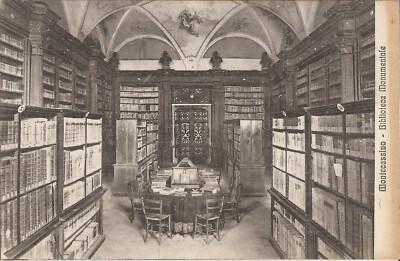
Another treasure trove of ancient scripts is Montecassino Monastery in Italy. This library officially used curses (called anathemas) on its books to deter theft. The practice is documented a Montecassino book called Incunabulum Speculum historiale by Vincent de Beauvais. Books were also chained to lecterns to prevent removal.
The library is known for ancient medical texts of Arabic/Islamic, Greek and Christian origin. In 1943, 1400 manuscripts were removed for “safekeeping” by the Germans. They were said to have been moved to the Vatican. Shortly thereafter, allied forces bombed the monastery. It’s unclear whether the documents were looted or saved or why the Americans bombed the place.
The Abbey was built on a site that featured statues of Apollo and other bronze figures. Along with the curses on books, these are interesting choices for an ostensibly Christian monastery. 
Another Monastery full of ancient artifacts and books is Cluny Abbey in France. Much of the place was burned down during the “French Revolution” (what a wonderful revolution that must have been).
Citeaux Abbey in France housed over 12 000 old manuscripts, many of them as weird as the image below (taken from a book at that monastery):
Mount Athos is a monastic peninsula in northern Greece. It houses one of the world’s richest collections of Byzantine, medieval, and early modern manuscripts across its more than 20 monasteries. These libraries contain thousands of Greek, Georgian, Slavic, and other texts—many still largely unstudied or untranslated—along with rare books, documents, and artifacts. Access is heavily restricted, women aren’t allowed to visit, even academics are prevented from entering. I wish to ask “What are they hiding?” but if we consider that most monasteries have been subject to looting, fires, vandalism and theft, maybe their secrecy derives from that. Mount Athos houses books that are “disputed” by our Academics because they debunk certain narratives (or because they can’t access it).
From the late 900s onwards (but not before that!) monasteries compiled so called Cartularies to organize land deeds, privileges, and rights. Early examples include Redon Abbey (Brittany, 9th century) and Fulda (Germany). They helped assert legal claims and institutional memory.

Many English monastic archives were disrupted or dispersed during the Dissolution of the Monasteries (1536–1540 under Henry VIII), but significant portions survived in the British Library, The National Archives, or cathedral collections.

Cathedrals also maintained records. Durham Cathedral in England is one of the largest and most complete English cathedral archives. What time frame does it cover? If you guessed 1000 years, you got it right. It includes medieval charters, account books and national documents such as the Magna Carta. Canterbury Cathedral also holds records dating back approximately 1000 years, Exeter Cathedral in Dublin holds documents dating back 900 to 1000 years. It’s almost as History began 1000 years ago. 

Bishops’ registers (records of ordinations, visitations, wills, etc.) began systematically in the 12th–13th centuries. These archives preserved ordinations, visitations, wills, religious texts, land tenure, records of law, economy and genealogy. 

Summary: Something happened 1000 years ago that reset the whole world.


Knowledge dissemination relies on YOU. Share this article far and wide
error: Content is protected !!